Losing someone you love is one of the hardest moments a family will ever face. In the middle of grief, you are suddenly asked to make decisions, contact a priest, and arrange a farewell that honours a lifetime of faith. We understand how overwhelming that can feel, and we are here to carry the weight with you.
For more than forty years, our team at Ang Brothers has walked beside Singapore families through their final goodbyes. This guide explains what a Catholic funeral involves, how the liturgy unfolds, and everything we quietly handle in the background so that you and your loved ones can grieve, pray, and be present with one another.
A Catholic funeral is far more than a ceremony. It is an act of faith and hope, a prayer that entrusts the person who has died to God’s mercy while offering comfort to those left behind. The Church gathers the family and community to give thanks for a life, to pray for the soul of the departed, and to affirm the promise of eternal life.
Because the funeral is rooted in liturgy and the sacraments, everything moves with reverence and order. Our role is to make sure the practical arrangements support that sacred rhythm and never disrupt it. When you understand how the days ahead will flow, the whole experience feels far less daunting.
Most Catholic funerals in Singapore unfold across three distinct moments over several days. Each one carries its own purpose and its own quiet beauty.
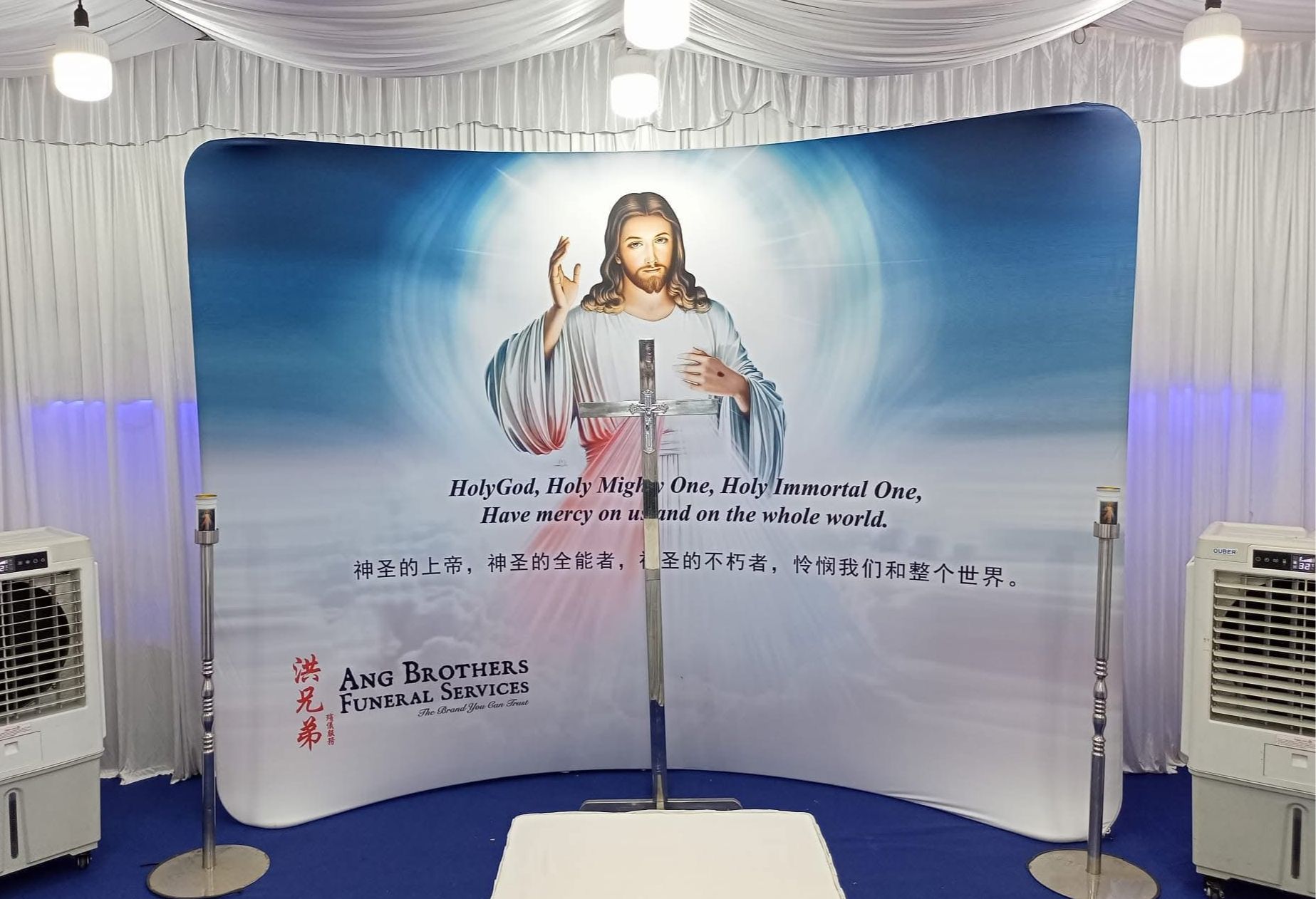
The wake is usually held over one to three evenings, often at a void deck, a parish hall, or a funeral parlour. Family and friends gather beside the casket to pray, share memories, and keep watch. Each evening, the Rosary is prayed together, a gentle and familiar devotion that brings great comfort. We set up the wake space with dignity, arrange the seating and refreshments, and make sure everything is ready before your guests arrive.
The heart of a Catholic farewell is the Funeral Mass, celebrated in the family’s church and led by a priest. The casket is received at the entrance, blessed with holy water, and the community prays together through the readings, the homily, and Holy Communion. We coordinate the timing, transport the casket to the church with care, and work closely with the parish so that the Mass proceeds smoothly.
After the Mass, the family accompanies their loved one to the place of committal. This may be a cremation at Mandai, or a burial at a Catholic cemetery such as Choa Chu Kang. The priest offers final prayers of farewell before the body is laid to rest or committed to the flames. We manage the procession, the booking, and every detail at the site, so the family can simply be present.
Every parish keeps its own schedule and customs, and the priest’s availability often shapes the timeline. Our team speaks with the church on your behalf, confirms the date and time of the Funeral Mass, and aligns the wake and committal around it. If your family has not been active in a parish for some time, we can help you make contact and find a priest to preside.
If you are unsure where to begin, our guide on how to arrange a funeral in Singapore walks through the sequence one step at a time.
Behind every peaceful farewell is a long list of tasks that most families never see. We take care of all of it, from the first phone call to the final prayer.
When you call, we collect your loved one from the hospital, home, or nursing home at any hour. Our embalmers then prepare the body with care and respect, dressing and grooming the deceased so that family can view them peacefully during the wake.
We register the death and obtain the necessary permits, then secure your slot for cremation at Mandai or a plot at a Catholic cemetery. You will never have to queue at a government counter or puzzle over paperwork while you are grieving. You can see the full scope of what is included in our funeral packages.
Families often worry about cost at the worst possible time, so we believe in being clear and honest from the very start. The final figure depends on a handful of real factors rather than any hidden markup.
We give every family a clear, itemised quotation, so you can see exactly what you are paying for with nothing buried in the fine print. If you would like a realistic sense of figures, our overview of how much a funeral costs in Singapore is a good place to start, and you are always welcome to call us for a tailored estimate.
The moments right after a passing are often the most confusing. Take a breath. You do not have to know everything at once, and you do not have to face it alone.
Once you reach us, we take over the arrangements immediately. For a calm overview of the official steps, our guide on what to do when someone dies in Singapore lays everything out plainly.
We have served Buddhist, Taoist, Christian, Catholic, Soka, and free thinker families across Singapore for four decades. For Catholic funerals, that means we know the liturgy, honour the sacraments, and work hand in hand with your parish. Our care is warm, our pricing is transparent, and our team is reachable around the clock. You can read more about our Catholic funeral care, or simply reach out to our team whenever you are ready.
Most Catholic funerals run over three to five days. The wake is usually held for one to three evenings with nightly Rosary prayers, followed by the Funeral Mass and the committal on the final day. We tailor the timeline around your parish and your family’s needs.
Yes. If your family has drifted from regular church life, we can help you make contact with a parish and arrange a priest to lead the prayers and the Funeral Mass. We do this gently and without any judgement.
We do. We can book a cremation slot at Mandai or a plot at a Catholic cemetery, obtain the permits, and manage the procession to the site. We will talk you through the options so the choice feels clear and unhurried.
Immediately. Call us at any hour and our team will collect your loved one and start the arrangements straight away. There is no wrong time to reach out and no obligation in asking.
If you have just lost someone, or you simply want to understand your options, please call or WhatsApp our team at Ang Brothers on 9871 8388. We are here at any hour, with no obligation, ready to listen and to help you plan a farewell that honours your loved one’s faith.
Speak to us now. No pressure, no obligation, just clear answers and immediate help.